Assisted Dying in Switzerland
and FEN’s Swiss Option Advisor
Traveling to Switzerland to access medical aid in dying (MAID) is an option for choice in dying that has been getting increased attention in the US. The Swiss call this voluntary assisted dying (VAD). Swiss laws on VAD are much more compassionate in whom they serve than US MAID laws, which are very restrictive. Swiss law only requires that 1) anyone assisting in a chosen death must not have selfish motives, 2) the individual choosing to die must have decision-making capacity, and 3) the individual choosing to die must perform the final action that will bring about death. Importantly, Switzerland allows non-Swiss citizens to come to Switzerland to receive medical support for VAD.
To take advantage of VAD in Switzerland an individual must be over the age of 18.
Advantages
- People who do not qualify for MAID in the US, often do qualify for VAD in Switzerland.
- The physical requirements of self-administering the lethal medication or pressing a button are significantly less than what is required to use inert gas for self-deliverance in the US.
- Some people want to avoid exposing friends or family to the real or imagined legal complications in the US of do-it-yourself methods of self-deliverance.
Disadvantages
- The costs of VAD in Switzerland plus travel are considerable.
- Assembling the necessary paperwork can be challenging.
- The physical demands of traveling abroad can be strenuous.
The following Swiss organizations work with English-speaking non-Swiss citizens seeking VAD:
Dignitas
- Founded in 1998 and located in Forch, southeast of Zürich
- Administers medication orally unless intravenous administration is necessary
- https://dignitas.ch/en
- Email dignitas@dignitas.ch
Pegasos Swiss Association
- Founded in 2019 and located in Basel with a VAD residence in the Solothurn countryside
- Administers medication intravenously
- https://pegasos-association.com
- Email contact@pegasos-association.com
Athanasios
- Founded in 2025 and located in Basel
- Administers medication intravenously
- https://athanasios.ch/en/home
- Email contact@athanasios.ch
Phönix Care (Phoenix Care)
- Founded in 2025 and located in Gempen, south of Basel
- Administers medication intravenously
- https://www.phoenix-care.ch/home-en
- Email contact@phoenix-care.ch
The Last Resort (not accepting applications, Dec 2024)
- Founded in 2024 without a physical location
- Provides non-medical VAD via the Sarco, a device that rapidly produces nitrogen hypoxia
- https://www.thelastresort.ch
- Involved in court proceedings challenging the legality of its self-deliverance method, so not accepting applications as of Dec 2024
Those applying for VAD in Switzerland must be over the age of 18 and meet the requirements of the Swiss law; they must have decision-making capacity and the physical ability to perform the last step of the VAD process (drinking the medication or opening an IV line containing the medication). All organizations require the individual’s choice to be their own and stable over time. Those applying for VAD with Dignitas or Pegasos must be a member of the organization.
Each organization has slightly different criteria, described below, but none requires a terminal diagnosis, and most will work with an individual suffering from the maladies of advanced old age. For individuals who feel their life is complete but who are in good health, Pegasos believes choice in dying is a human right, and both Athanasios and Phönix Care indicate they consider age and the increased probability of an incapacitating medical event in their application evaluations.
The Dignitas website states applicants must have “a disease which will lead to death (terminal illness), and/or an unendurable incapacitating disability, and/or unbearable and uncontrollable pain.”
The Pegasos website states, “Pegasos believes that it is the human right of every rational adult of sound mind, regardless of state of health, to choose the manner and timing of their death.”
The Athanasios website states, “We place particular emphasis on understanding the unique situation of each individual … We do not only support people with terminal illnesses, but also older individuals or couples who wish to journey together in their final chapter …” For the application, “…, alternatives must be considered, and a medical certificate confirming the diagnosis or unbearable suffering must be provided.”
The Phönix Care instructions describe the medical requirements as, “Terminal illness or unreasonable disability or unbearable pain and suffering.” They note that “Elderly people in particular should have easier access to a VAD. From the age of 85, the probability of suffering an acute event that leads to incapacity but not death increases enormously.”
The Swiss organizations will provide VAD for individuals with a dementia diagnosis, but the person must have decision-making capacity at the time of the VAD. You have decision-making capacity for VAD if you understand your diagnosis and the options available to you, and you can communicate your reasoning for choosing VAD and demonstrate that you understand the consequences of your choice (death is permanent). Typically, one retains decision-making capacity in early-stage dementia (stage 4 of the Global Deterioration Scale), but symptoms and disease progression vary between individuals. There is no bright line between one stage and the next, nor is there any formula or fail-safe method to forecast when one will lose decision-making capacity, which makes the question of timing incredibly challenging.
The Swiss organizations will want to assess the person’s capacity before they travel to Switzerland and then again at the time of the VAD. For applicants to Dignitas, the pre-travel capacity assessment must be done in the US, where it can be difficult to find a doctor willing to do an assessment for the purpose of VAD. Applicants to the other Swiss organizations usually can have the pre-travel capacity assessment via videoconference with a Swiss doctor. Keep in mind that travel can be particularly disorienting for someone with cognitive impairment or dementia, and someone who demonstrated capacity prior to travel may not be able to do so upon arrival.
For the organizations providing medical VAD (Dignitas, Pegasos, Athanasios, and Phönix Care), there are at least three costs one should anticipate. Pricing structures are always subject to change, and applicants for VAD should confirm with the organization at the time of application. While there may be circumstances under which a partial refund of an accepted application or final-VAD fee might be issued, do not plan on it.
All organizations philosophically believe that financial resources should not be a barrier to accessing VAD, but have considerable operating expenses. Dignitas may be able to offer reduced membership and/or VAD fees for individuals with modest financial resources; any arrangement must be made directly between the member and Dignitas. Pegasos and Athanasios hope to be able to offer reduced fees in the future for those with financial need. Switzerland’s currency is the Swiss Franc (CHF). Check the current exchange rate to get an estimate for the cost in US Dollars.
- An initial/annual membership or supporter fee
For Dignitas, there is a one-time fee to join of CHF 220 and an annual fee CHF 80 after that. Pegasos membership is CHF 100 annually. Athanasios charges a registration fee of CHF 100 at the time of initial application for a personal informational meeting. Phönix Care has a one-time registration fee of CHF 100 plus an annual membership fee of CHF 50. - Fee for the VAD process
This is typically paid in two installments, the first at the time of application and the second prior to scheduling the VAD. The fee includes services provided by the organization and their medical VAD providers, as well as cremation, shipping the cremains to the US, and the death certificate. Occasionally, situations require additional review or additional medical or capacity screenings, and those would be an additional cost. The base fee for VAD with Dignitas is CHF 11,000. For Pegasos it is CHF 10,000. For Athanasios it is CHF 9,500. For Phönix Care it is CHF 10,600. - Travel and lodging expenses
Travel expenses can vary widely depending on where you are and how far ahead you are scheduling, but plan both for your travel expenses, and the travel expenses of a companion. The latter might not be needed, but circumstances and requirements vary.
Swiss VAD organizations use the terminology “green light” to signify that an individual’s application has been provisionally accepted. Provisional acceptance means that the organization has reviewed the application and believes that they will be able to support the individual seeking VAD. All approval is provisional, because the final decision ultimately rests with the organization’s physician, whom the individual will not meet until arriving in Switzerland. By law, the Swiss organizations must verify that the person has decision-making capacity at the time of the VAD, so they cannot guarantee a VAD ahead of time.
Applicants should expect to supply medical records with their application, though their use varies between the organizations. Medical records are used to satisfy government regulations, evaluate acceptance criteria, and check for contraindications to the medications or method used for VAD. Even when a person’s request for VAD is not based on a medical diagnosis, the doctor who performs the in-person assessment in Switzerland needs a foundation from which to evaluate the individual’s VAD request and check that treatment options have been considered, though the person is not required to try those options.
A psychiatric assessment is not always required, but applicants with a mental health diagnosis should expect it. For applicants to Dignitas, the assessment must be done in the US, where it can be extremely difficult to find a psychiatrist willing to do an assessment for the purpose of VAD. Applicants to the other Swiss organizations may be able to have the assessment via videoconference with a Swiss doctor or in Switzerland where psychiatrists are much more comfortable with the idea of VAD.
Once your paperwork is submitted, plan for at least six weeks, though they may be able to expedite the process if medically necessary. The time it takes to assemble the paperwork, however, can be quite variable. Because Swiss authorities require specific documentation, it is advisable to begin the application process at least six months in advance. While you may be able to apply with existing versions of some documents, other documents, including birth, marriage, and divorce certificates, may need to be re-issued within six months of the VAD, and possibly certified by a notary public. If you were born, married, divorced, or widowed in a country where those records are difficult to get or may no longer exist, the application process will be challenging.
The Swiss organizations strongly encourage those applying for VAD to share their plans with their loved ones, but it is not required. That said, aggrieved family members who opposed choice in dying have cost the Swiss organizations a lot of money and time in legal proceedings, so a person traveling to Switzerland without their family’s knowledge may be required, once they are in Switzerland, to call their family with a representative of the organization present. This is to be sure the family knows, not to get the family member’s permission. If a family member is vehemently opposed, they could call the Swiss or US authorities, which could trigger an additional capacity assessment, but as long as the person is of sound mind, the family’s objection cannot stop the person from receiving VAD.
The Swiss government wants to be very sure that the person whose name is on the death certificate is, in fact, the person who died. The easiest way to do this is to be accompanied by a relative who can identify the body for the authorities. It is fine if this person is in your will or stands to financially benefit; a representative of the Swiss organization will assess your motivations to be sure you are not being coerced. It is possible to be accompanied by a friend or possibly even an acquaintance, such as a death doula, but it is helpful to have a picture of you and the friend/acquaintance in an identifiable location in the US to establish your connection prior to arriving in Switzerland (by the post office, a sign for a town or park, a building visible in Google Maps street view). For a person who does not have anyone who can accompany them, it may be possible to provide specific dental records to confirm your identity, but check with the Swiss organization you are working with for exactly what is needed.
The Swiss organizations welcome loved ones to be present at the death, but people worry about legal ramifications. With the caveat that this is general information — not legal advice — there are theoretical and practical perspectives on this question. The short answer is that the legal risk appears very low. Americans have traveled to Switzerland for more than 20 years. Many have been accompanied by friends or family, but we are not aware of any US case in which a person was prosecuted for accompanying someone to Switzerland for an assisted death.
In Theory
Many US states have statutes prohibiting “assistance” in a suicide. The word “assistance” has always been interpreted in this context to mean physical assistance, not speech, though there is one outlier state, Minnesota, which criminalizes speech—which we and other legal scholars think is unconstitutional. Therefore, it is conceivable that any physical action a person takes in the chain of events leading to another person’s chosen death in Switzerland, such as purchasing their plane ticket or driving them to the airport, could be interpreted as assistance in a suicide and prosecuted. It would be hard to argue that merely being on the same plane as someone choosing to hasten their death in Switzerland is assistance, because one person’s sitting on a plane is not a physical act in the chain of events of another person’s journey, though that doesn’t mean a prosecutor couldn’t try.
In Practice
That said, we are not aware of any individual in the US who has been investigated or prosecuted for accompanying a loved one to Switzerland for an assisted death. Professor Thaddeus Pope addressed this question in his blog on end-of-life law and policy, and notes that there have been some high profile examples of accompanying a loved one to Switzerland, including, more recently, Amy Bloom who chronicled her and her husband’s journey to Switzerland in her book, In Love.
Swiss death certificates do not list the cause of death. That is considered private medical information under Swiss law. Swiss medical confidentiality is primarily governed by Article 321 of the Swiss Criminal Code, which protects patient privacy. For life insurance, you should check your individual policy, but in the US, the contestability period during which a life insurance company can deny benefits if the insured dies by suicide is typically only two years from the start of the policy. As a practical matter, most people applying for VAD will not have taken out a life insurance policy within two years of their VAD because of their age or health conditions. However, insurance companies have refused to pay benefits without cause of death, regardless of how many years the decedent had the policy. The US Embassy in Bern suggests writing a letter to the Public Prosecutor in the canton of where the person died and requesting a statement of cause of death for US insurance purposes.
For infrequent travelers, the logistics of an international trip may seem overwhelming, but the Swiss organization you work with will help you with these questions. They each have a preferred method of communication (cell phone, WhatsApp, Signal). They will know the local transportation, lodging, and food options, and can help with dietary restrictions. They can suggest where to donate items, such as clothing or walkers, that won’t be needed after the VAD, and can help with other travel and logistics questions.
People with walkers and wheelchairs can take commercial flights. Check with your airline for their procedures.
Final Exit Network has a volunteer Swiss Option Advisor who can answer questions and provide guidance. This service is provided free of charge, but is information only. To reach our Swiss Option Advisor:
- Call our toll-free number 866-654-9156, or
- Use the Exit Guide Service and End of Life Options form on our “Contact Us” page.
Another excellent source of information is The Switzerland Alternative.
See FEN’s Spring 2026 magazine for stories from people who supported a loved one in their journey to Switzerland.
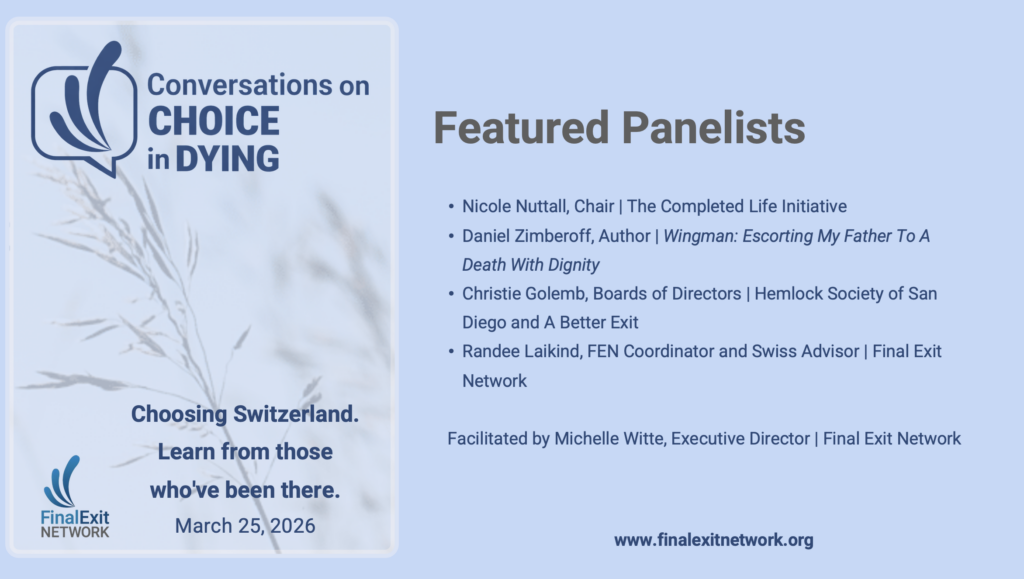
On March 25, 2026, FEN hosted a webinar in which we provided an overview of the options available in Switzerland and how to best learn about and access their services. Hear the stories about how the loved ones of our panelists died, but also how they lived – and their commitment to end their lives on their own terms. (NOTE: You can also click on the image below to access the video.)